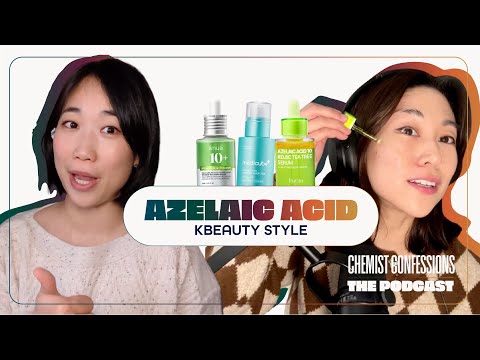
 Plays from YouTube when you click
Chemist Confessions · January 28, 2026 · 00:38:54 · 19,277 views
Chemists test three K-beauty azelaic acid serums, then: the main claim
Three popular K-beauty azelaic acid serums are fine as supporting products, none is a heavy lifter for acne or pigment, and the clear, fully dissolved formulas are not automatically better or worse than the chalky suspensions.
Half right, and the right half needs no trial. The hosts read labels better than most reviewers. They catch that one serum's tea-tree claim is a leaf water, with the oil at 0.005%. They catch that a "20" on one product page counts a whole actives complex. They also catch that the microneedle product carries 0.01% azelaic acid against 10% in the other two. Then the video runs out of road. It has no clinical yardstick for the question a shopper cares about most: does any of this do what the tested drug does?
That yardstick exists, and it makes the hosts' skepticism look better than they argue it. In the two phase III rosacea trials (n=664), the vehicle gel alone cut inflammatory lesions 40% and 39%, against 58% and 51% on the 15% gel. A brand photo with no control arm cannot separate those two numbers. The video never says so.
It also skips rosacea, the only condition the US label covers, and it gives no trial length for the hosts' own testing. A large share of the runtime goes to texture and feel. Useful if you are choosing between three bottles on a shelf, thin if you are asking whether azelaic acid will clear your skin.
Chemists test three K-beauty azelaic acid serums, then: what holds up
- Reads the labels sharply. The tea-tree figure is a 10% leaf water with the oil at 0.005%, and a "20" on the listing counts a whole actives complex. A review of marketed products found cosmetic and drug-status azelaic acid products ranging from 5% to 20%, so a number on the bottle means little without the ingredient list. Source
- Treats the brand's own evidence as thin. The consumer panel had 22 people aged 20 to 59, the redness test used tape-stripped skin (no one had rosacea), and the 108.6% spot-improvement figure came with no group size or statistics. A vehicle arm shows why that matters: in the 2003 phase III rosacea trials (n=664), vehicle gel cut inflammatory lesions 40% and 39%, against 58% and 51% on the 15% gel. Source
- Says a cosmetic azelaic acid serum should not stand in for benzoyl peroxide. The Cochrane abridged review of topical acne treatments (2020, 49 trials) judged azelaic acid probably less effective than benzoyl peroxide on participant global assessment (RR 0.82, 95% CI 0.72 to 0.95) and about equal to tretinoin. The AAD acne guideline gives azelaic acid a conditional recommendation, with strong ones for benzoyl peroxide and topical retinoids. Source
- Calls the microneedle product the odd one out, and the arithmetic backs them. It lists 0.01% azelaic acid. The lowest concentration in the trials I checked is 5%, where azelaic acid alone cut an acne severity index by 32.46% over 12 weeks in a 150-person multicenter trial that also had clindamycin arms. No trial tested a trace amount. Source
- Is realistic that none of the three is a pigment workhorse. In a 2023 meta-analysis of 6 RCTs (n=673), azelaic acid gave a lower MASI than hydroquinone in melasma (mean difference -1.23, 95% CI -2.05 to -0.40). The melasma trials I hold used a 20% cream, a long way from a 10% cosmetic serum or a trace amount. Source
Chemists test three K-beauty azelaic acid serums, then: what it skips or gets wrong
- Treats redness as a marketing claim and moves on. It never says that the only US label indication for 15% azelaic acid gel is the papules and pustules of mild to moderate rosacea, and that the label says efficacy for erythema without papules and pustules has not been evaluated. A 2006 systematic review of 5 RCTs (n=873) found no study showing a drop in telangiectasia. Source
- Credits stinging to poorly processed suspensions and offers clear serums as the comfortable option. The drug-grade evidence cuts against a clean split. In the 12-week phase III foam trial (n=961), 67.8% of foam users rated tolerability excellent or good against 78.2% on vehicle foam, so a well-made formula still irritates some people. No trial I hold compares a raised-pH clear solution with a suspension. Source
- Repeats that a 15% foam matched a 20% cream because of better delivery. The foam phase III trial (n=961, 12 weeks) compared foam with vehicle foam and won on investigator global success (P<.001). I found no head-to-head against the cream, so treat the equivalence claim as unverified. Source
- Points pigment-minded viewers to a derivative-blend serum as the real workhorse without citing a trial for it. The melasma data are for melasma, not post-acne marks or general uneven tone, and the hosts do not say which kind of pigment their advice covers.
- Judges four-week brand tests without naming the real yardstick, which is 12 weeks. The rosacea label says to reassess the diagnosis if there is no improvement after 12 weeks, and the head-to-head with 0.75% metronidazole gel ran 15 weeks (n=251, lesions down 72.7% vs 55.8%). The hosts also never say how long they used each serum. Source
Chemists test three K-beauty azelaic acid serums, then: strengths and weak spots
Strengths
- Decodes ingredient lists in plain terms, including the leaf water versus oil distinction
- Gives the one brand that ran tests credit while still picking apart what it shared
- Admits what the hosts cannot know about dissolved azelaic acid and efficacy
- Tells viewers outright that no cosmetic serum replaces better-tested acne actives
Weak spots
- Cites no clinical trial for azelaic acid itself
- A large share of the runtime goes to texture, which varies by skin and tells you nothing about results
- Skips rosacea, the only labelled use, and the weak erythema evidence
- The pigment recommendation has no source behind it
Chemists test three K-beauty azelaic acid serums, then: our recommendation
Skim. Watch the ingredient and testing-critique segments, where the hosts pull apart the tea-tree, complex and trace-amount claims, and skip the texture demos. Before spending money, read the 2003 phase III rosacea abstract to see what a vehicle-controlled result looks like (PubMed 12789172), and ask a clinician about the approved gel if rosacea bumps are the problem.