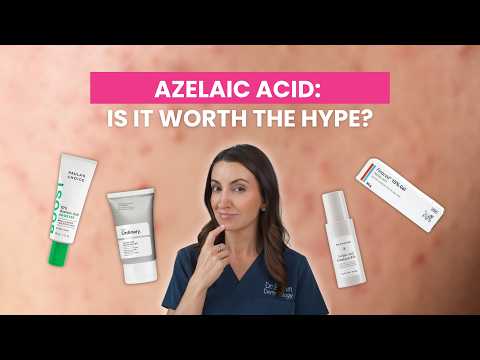
 Plays from YouTube when you click
Dr. Aleksandra Brown DO, FAAD · October 12, 2025 · 00:08:30 · 18,302 views
Aleksandra Brown's azelaic acid explainer, claim by: the main claim
Azelaic acid calms redness, treats acne and fades pigment, its 15% prescription forms are approved for rosacea, and it is fully safe in pregnancy and breastfeeding.
A solid overview with two overstatements that matter. Brown gets the strength tiers right, describes the acne comparison with tretinoin fairly, and sets an honest expectation of about 12 weeks before judging results. Those are the parts most viewers will act on, and they hold up against the records.
The first overstatement is pregnancy. Brown calls azelaic acid 100% safe for anyone pregnant or breastfeeding. The label is reassuring but narrower. Little drug reaches the bloodstream, azelaic acid is naturally present in human milk, and the pregnancy section rests on oral animal studies with no human trial. Low expected risk is a fair summary; a guarantee goes past what anyone has tested.
The second is redness. The video says the 15% gel and foam won approval after trials showed improvement in redness and bumps. The approval covers the inflammatory papules and pustules of rosacea, and the label adds that efficacy for redness without those bumps was never evaluated. Someone with flushing alone sits outside what the trials tested.
Smaller points: no record compares the foam with the gel for irritation, and the word gentle sits awkwardly beside a label that reports burning, stinging or tingling in 29% of trial users.
Aleksandra Brown's azelaic acid explainer, claim by: what holds up
- Gives over-the-counter strengths of 5 to 10% and prescription strengths of 15 to 20%. Marketed products in the records span 5% to 20%, and the US label covers a 15% gel for rosacea. Source
- Says 20% azelaic acid can work almost as well as tretinoin for acne with less irritation. A 381-person study found 20% cream equal to 0.05% tretinoin for comedones with fewer local side effects, and a Cochrane review found little or no difference between the two on participant ratings. Source
- Warns that results take about 12 weeks. The label tells prescribers to reassess the diagnosis if nothing improves after 12 weeks of treatment, which lines up with the timeline in the video.
- Describes antibacterial action and slower keratin buildup inside follicles. A placebo-controlled acne study measured falling skin bacterial density with 20% cream, and the same body of work found no change in sebum, which the video never claims. Source
Aleksandra Brown's azelaic acid explainer, claim by: what it skips or gets wrong
- Calls it 100% safe in pregnancy and breastfeeding. The label expects minimal fetal exposure and notes azelaic acid occurs naturally in breast milk, but the pregnancy data are oral animal studies at 19 to 162 times the maximum human dose that showed embryotoxicity, with no human trial on record.
- Says the 15% gel and foam were approved after trials showed improvement in redness. The label indication is the inflammatory papules and pustules of mild to moderate rosacea, and efficacy for erythema without them has never been evaluated.
- Says the foam tends to irritate less than the gel. The 961-person foam trial compared foam with its own vehicle, where tolerability was rated excellent or good by 67.8% on foam and 78.2% on vehicle, and no record compares foam with gel. Source
- Calls it gentle enough for skin that cannot tolerate stronger agents. In repeated-application tests on healthy skin, irritation from the 15% gel built up over time while metronidazole and petrolatum caused none. Source
- Leaves out the label's advice to watch darker skin for hypopigmentation, which matters because the same video recommends azelaic acid for post-inflammatory marks and melasma.
Aleksandra Brown's azelaic acid explainer, claim by: strengths and weak spots
Strengths
- Strength tiers for shelf and prescription products are accurate.
- Fair summary of the acne comparison with tretinoin.
- Sets a realistic timeline of about 12 weeks.
Weak spots
- Overstates pregnancy and breastfeeding safety.
- Stretches the rosacea approval to cover redness alone.
- Calls it gentle despite the label's irritation rates.
- Product picks come with shopping links that may pay the channel.
Aleksandra Brown's azelaic acid explainer, claim by: our recommendation
A good first explainer for strengths and timelines. Read the label's own indication and pregnancy sections before treating the redness or pregnancy claims in this video as settled.